Why don't children report abuse before they turn 18?
When a minor child makes a disclosure of abuse, instead of receiving immediate protection, they are subjected to a painful, exhausting, and psychologically draining process
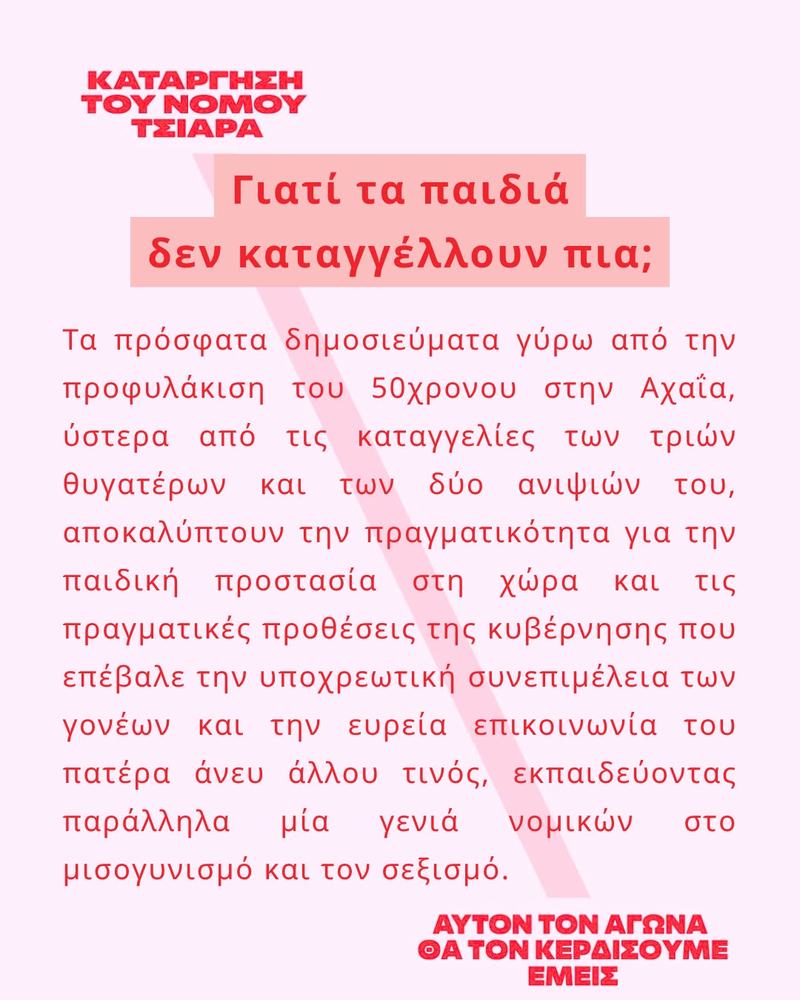
Αφίσα «Γιατί τα παιδιά δεν καταγγέλλουν πριν ενηλικιωθούν» @Καμπάνια Όχι στην Υποχρεωτική Συνεπιμέλεια
Published: October 12th 2026
© stopchildabuse.gr
READ ALSO
- 28/09/2026 Believe the children
- 03/12/2024 Urgent recommendation from GREVIO to Greece
- 22/03/2024 Prosecutor Maria-Eleni Nikolou and the patriarchal class courts.
- 08/10/2023 Legal rules establishing the obligation to report child abuse and neglect
- 08/10/2023 History Taking in Sexual Abuse: Anatomical Dolls
- 04/06/2023 UN Recommendation: legally prohibit the use of "parental alienation"
The recent reports surrounding the pretrial detention of the 50-year-old man in Achaia, following the allegations made by his three daughters and two nieces, reveal the reality of child protection in this country and the true intentions of the government that imposed mandatory joint custody on parents and extensive communication with the father above all else, while at the same time training a generation of legal professionals in misogyny and sexism. At the same time, it made the attack on the most vulnerable—that is, children—a central feature of the new family law, courtesy of Tsiaras. The only way a child in this country can report abuse after the Tsiaras Law is to become an adult first. In any other case, it will almost always be considered as having been suggested/coached by the "alienating" mother.
Despite the fact that our international and national legal system proclaims the protection of the child, everyday judicial practice proves that in Greece the violation of the International Convention on the Rights of the Child and the Istanbul Convention (Law 4531/2018) is structural and deliberate.
This is evident from some simple, empirical facts regarding the process of reporting the abuse of minors:
- The traumatic process of examining children: when a minor child makes a disclosure of abuse, instead of receiving immediate protection, they are subjected to a painful, exhausting, and psychologically draining process. Despite provisions for examination at the "Child's House" with a structured protocol, children are often called to give multiple statements, undergo pressuring interrogations, and forensic examinations—almost always with months of delay—which cause profound trauma, fear, confusion, and secondary victimization.
- The removal of custody from protective mothers: with the implementation of Law 4800/2021 and the abuse of the pseudo-theory of "parental alienation," the state mechanism has almost systematically turned against the mother who tries to protect her child in recent years. Instead of examining the validity of the allegation, the mother is accused of being an "alienator" and risks immediately losing custody or even parental responsibility. In the name of a coercive "reunification therapy," children are forced into communication or even cohabitation with the accused parent. If the mother does not hand them over, her custody is taken away. When she does hand them over, out of fear of permanently losing them and having them end up in the hands of the person who abused them, the judicial system tells her that since she handed them over, they are obviously not in danger, so she must have been lying!
- The Juvenile Prosecutor's Office, together with the Society for the Protection of Minors, function, at least in Athens and recently in Piraeus as well, as an extension of fathers' rights groups. Children are considered to have been coached (even at ages of adolescence) and orders are given for their removal by force—that is, with police cars—from their mother so that they can be handed over to the accused father; baby-carrying mothers who return to their place of origin so as not to lose their jobs are labeled as alienators through letters drafted within 24 hours and are ordered to return, at the very same time that the crime in Kypseli had an open case file at the Prosecutor's Office. Mothers who request assistance to get their children into therapy see their requests rejected and are themselves labeled, in a prosecutor's document, as "improperly exercising parental responsibility" because they did not inform the father that the child did not go to school one day. Teenage girls are ordered into "reunification therapies" with the father they reported. So where exactly are children supposed to report abuse?
- Debunking the myth of false allegations: the narrative that mothers make "false allegations" to take revenge on their ex-husband collapses in the face of common sense and research. Deliberately false allegations are extremely rare (1% to 5%), while unreported abuse constitutes the overwhelming majority. Why would a mother make a false allegation? To risk prison sentences of up to 20 years for violating court decisions, to endure enormous and unbearable financial costs for expert witnesses and courts, and to experience her complete physical and psychological breakdown? To risk her custody and hand her child over to an abuser? For what motive—two fewer days of the father's contact per month?
- Violation of international recommendations: GREVIO and the UN have explicitly called on the Greek authorities to abolish the use of "parental alienation" in judicial practice and to stop removing children from non-violent parents.
How many adults must report the abuse they suffered as children before the State takes action? How many times must a child repeat and relive their trauma? How many more children's voices will be silenced by prosecutors and judges? For how much longer will mothers who try to protect their children remain at risk?
We demand:
- that the Tsiaras Law (4800/2021) be dismantled and mandatory joint custody be abolished,
- that child-friendly hearing procedures be established and that children's reports finally be heard,
- that the State stop punishing mothers who protect their children,
- that the use of the pseudo-syndrome of parental alienation be banned everywhere and universally (by courts, prosecutors, mental health professionals, etc.), in accordance with the urgent recommendations of GREVIO and the UN to Greece,
- that Greece fully align itself with the Istanbul Convention, both at the legislative level and in judicial practice, by removing all the reactionary, misogynistic content currently being taught to new generations of judicial officers and prosecutors (see: the pseudo-syndrome of parental alienation, the labeling of protective mothers as "alienators," etc.)
Machine-assisted translation, reviewed and edited by a human.
READ ALSO
- 28/09/2026 Believe the children
- 03/12/2024 Urgent recommendation from GREVIO to Greece
- 22/03/2024 Prosecutor Maria-Eleni Nikolou and the patriarchal class courts.
- 08/10/2023 Legal rules establishing the obligation to report child abuse and neglect
- 08/10/2023 History Taking in Sexual Abuse: Anatomical Dolls
- 04/06/2023 UN Recommendation: legally prohibit the use of "parental alienation"